
Check Shoreline Voter Registration
King County’s My Voter Information tool is the direct self-service route for a Shoreline voter. It asks for any three of four matching identity fields. Enter them as they appear on the registration. The portal is not an open surname directory, so it cannot be used to browse everyone with the same last name. Washington’s VoteWA service provides a statewide route for the same personal task.
| Lookup field | Type | Required | Format |
|---|---|---|---|
| First name | Text | Any 3 of 4 | Use the registered form |
| Last name | Text | Any 3 of 4 | A single legal name belongs here |
| Date of birth | Date or text | Any 3 of 4 | MM/DD/YYYY |
| House or building number | Number or text | Any 3 of 4 | Number only |
| Submit | Button | Yes | Validates the chosen combination |
A valid match opens registration details, ballot status and tracking, and the contests tied to the voter. Registration data refreshes daily at midnight. Ballot tracking refreshes hourly from 8 a.m. to 8 p.m. A miss can stem from name formatting, an update still being processed, the wrong county, or an inactive or cancelled entry. Contact Elections before drawing a conclusion.
The official King County voter lookup shows the four-field login described above.
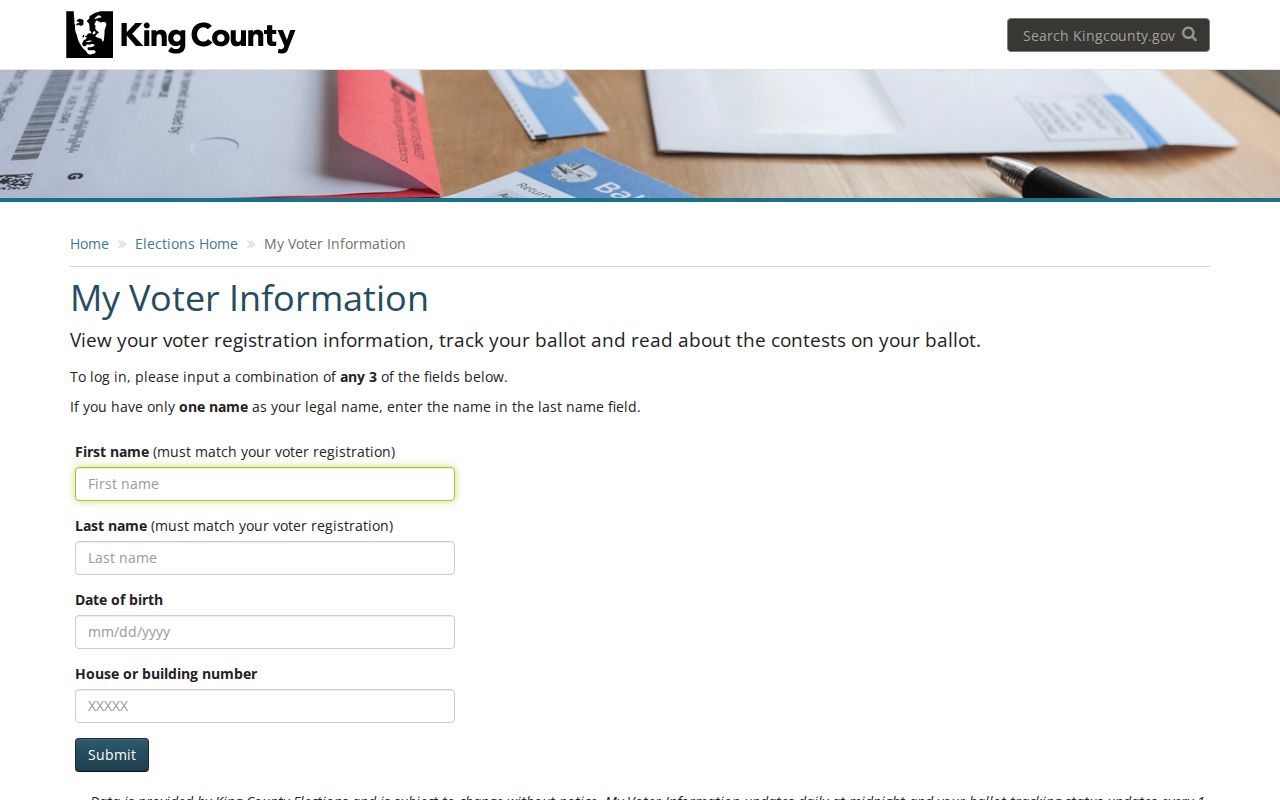
The captured screen confirms that any three fields may be used, a key detail when a voter does not have every registered detail close at hand.
Shoreline Voter Lookup Results
The personal lookup answers questions that the public extract does not. It can confirm whether the registration information on file is current, show the voter’s ballot status, and identify current contests. That makes it useful after an address or name change, when a ballot has not arrived, or when tracking a returned ballot. These are personal service details, not permission to inspect another person’s private account.
Why did a recent change not appear? County and state officials process address updates, returned election mail, death notices, felony-status changes, and duplicate records under state law and federal safeguards. Online changes are not always immediate. An inactive status can arise during a confirmation process, while cancellation requires separate statutory conditions.
Note: An unsuccessful login is not proof that a person is unregistered; exact formatting and processing time can control the result.
Public Washington Voter Record Fields
RCW 29A.08.710 identifies the voter information available for public inspection and copying, subject to protected-address and other confidentiality rules. The statewide voter registration database, or VRDB, uses more detailed fields to organize each voter, precinct, and political district. The public voting record means participation history. It never reveals a marked choice.
| Name and number | Registration number plus maintained first, middle and last name and suffix |
|---|---|
| Address | Residence address and a separate mailing address when supplied, unless protected |
| Election geography | County, precinct name and number, precinct portion, and political districts |
| Dates and status | Registration date, last update, and active, inactive, or extract-defined status |
| Personal fields | Year of birth and gender where disclosure law permits |
| Voting record | Current and prior-year participation, never ballot selections |
Washington does not register voters by party. A blank party field is not missing data, and no public record can disclose a choice that the registration system never collected. This state rule is a notable difference from jurisdictions that maintain party enrollment.
Shoreline Voter Records Kept Private
Public access has firm limits. The general disclosure does not include full Social Security or driver-license identifiers, signature images, ballot choices, protected phone or email details, or the actual residential address of an Address Confidentiality Program participant. The source agency that registered a specific voter, and a person’s choice not to register through an agency, are also withheld under RCW 29A.08.720.
Confidential by Washington law. Full identity credentials, signatures, marked choices, protected contact details, and ACP residential addresses do not become public merely because other voter fields may be inspected under RCW 29A.08.710 through .740.
A signature image cannot be sent to the voter or to anyone else. Public year-of-birth and participation fields must not be mistaken for a full birth date or a ballot history. Those boundaries protect both election integrity and the voter’s safety.
Request Washington Voter Registration Files
The Secretary of State’s VRDB extract request offers either a statewide file or a selected county file. Choose King County for records that include Shoreline. The requester must provide contact and address details, select one extract, and certify the political purpose allowed by law. Approved files arrive as delimited CSV data and may be large enough to require database software.
- Enter the requester’s first and last name, email, phone, street address, city, state, and ZIP code.
- Select the statewide file or the county option. Choose King County when requesting the local extract.
- Read and accept the statutory use certification, then submit the request for approval and email delivery.
The VRDB updates near the beginning of each month, generally by the first business day. Requests may take up to five business days, though some are fulfilled at once. The electronic data service states no charge. Older King County guidance allows copy charges for paper requests over 34 pages, so confirm any paper cost before ordering. Questions about the state extract go to elections@sos.wa.gov or 360-902-4194.
Washington Voter File Use Limits
The downloadable file and the identity-gated lookup serve different purposes. The personal tool helps one voter check registration and ballot service. The extract is released only after the requester certifies a political use. RCW 29A.08.740 limits voter-data use, while RCW 42.56.070(9) bars agencies from supplying lists of individuals for commercial purposes.
Public access never permits threats, impersonation, harassment, or exposure of a protected person. Washington’s stalking law appears at RCW 9A.46.110, and civil anti-harassment protection is governed by chapter 10.14 RCW. Use the official fields only for a lawful certified purpose. Do not republish protected details or treat a public address as an invitation to contact someone.
Two tools, two boundaries. My Voter Information is a private self-check. The VRDB extract requires certification and may not be turned into a commercial contact list.
Shoreline Voter Records Contacts
King County Elections handles local voter service and public-record requests. Its office is at 919 SW Grady Way, Suite 100, Renton, WA 98057, and public hours are Monday through Thursday, 8:30 a.m. to 4:30 p.m. Call 206-296-VOTE (8683), use 800-325-6165 from outside the 206 area, email elections@kingcounty.gov, or fax 206-296-0108.
King County Elections
Registration, ballots, precincts, and voter service
206-296-VOTE (8683)
elections@kingcounty.gov
Public Records Officer
Election-record requests and status
206-296-1565
ElectionsPDR@kingcounty.gov
A useful written request defines the geography, record status, snapshot date, participation history, and desired format. Say whether “Shoreline” means the city boundary, a legislative district, or named precincts. Clear scope helps Elections locate the right extract without guessing.
The official elections contact page displays the public-record and voter-service channels.
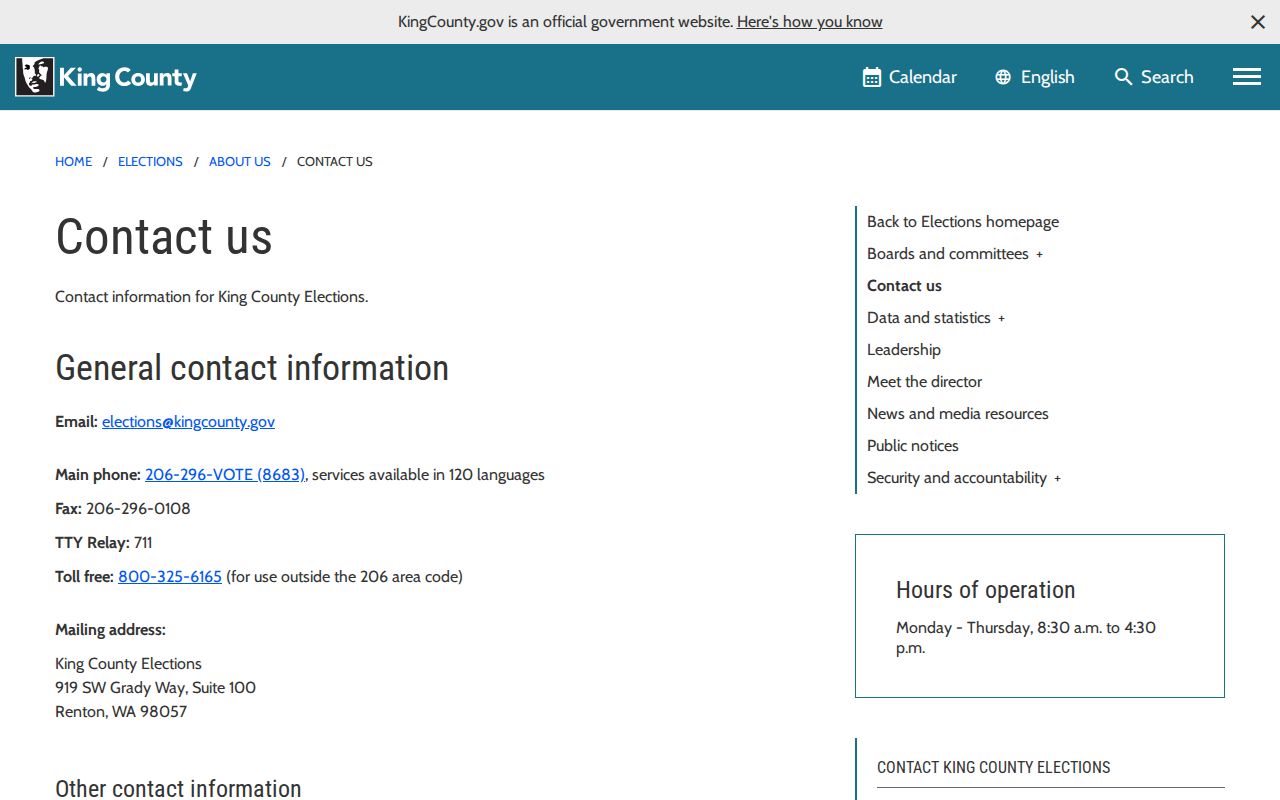
The screenshot provides a visual check on where routine voter questions and election public-record requests separate into distinct contact paths.
Shoreline Voter Roll Status Changes
Active, inactive, and cancelled are not interchangeable labels. Election officials update records after voter submissions and information from lawful maintenance sources. Returned or forwardable mail may begin a confirmation process. Death records, duplicate registrations, and qualifying felony-status changes can also affect an entry, but state procedures and National Voter Registration Act safeguards control when a record changes.
An inactive record has not necessarily been deleted. Cancellation occurs only when the statutory conditions are met. If the personal lookup shows an unexpected result, ask King County Elections to review the registration rather than relying on a third-party copy of an older voter roll. A monthly extract may lag behind a very recent change even when the voter’s county file has been updated.
Shoreline Voter Geography and Privacy
A postal city, municipal limit, neighborhood, census tract, and election precinct describe different boundaries. Shoreline sits within King County, yet a mailing label alone may not establish which precinct or city district applies. King County publishes turnout and registration maps by census tract for broad geographic context. Those maps should be used to understand areas, not to identify individual residents.
Washington’s Address Confidentiality Program, governed by chapter 40.24 RCW, provides a substitute mailing address for qualifying survivors and certain protected workers. A voter may also use a nontraditional residence description, such as a park, shelter, or intersection, while providing a valid mailing address. Suppressed or unusual address data is not evidence that the person does not live in the area.
Note: Define Shoreline election geography before requesting a file, since city, ZIP, precinct, district, and census boundaries can produce different groups.
Historical Shoreline Voter Registers
Older voter research follows county geography. Shoreline incorporated in 1995, while King County was organized in 1852. Earlier poll books and voter registers are therefore more likely to be cataloged under King County Elections, an old precinct, or a community name than under the modern city government. Boundary and name changes are the central search hazard.
The Washington State Archives catalog covers physical holdings that include voter registers, election returns, and poll books. Search by the creating office, precinct, and date. The Washington Digital Archives carries selected digitized election collections, but not every physical series. Historical poll books can document participation and election administration; they still do not reveal how a named voter marked a ballot.
For family history, record each old precinct label and date before moving to the next source. A failed search for “Shoreline” may reflect catalog geography rather than a missing record. That distinction is especially important for material created before the city existed.